Inspired by global networks, the initiative was created in 2025. It brings together academic institutions, government bodies, and civil society organizations with the aim of promoting more informed, contextualized, and collective well-being–oriented decision-making.
A network that recognizes the potential of using the best available evidence and of advocacy efforts from different sectors of society to support contextualized decision-making. This is how the Colombian Network for Evidence and Policy Advocacy presents itself to the world. The initiative was proposed by the University of Antioquia (UdeA), through the Vice Presidency for Research, the Unit for Evidence and Deliberation in Decision-Making (UNED) of the Faculty of Medicine, and the project to create the Policy Advocacy Support Unit of the National Faculty of Public Health.
With the support of the Latin America and the Caribbean Evidence Hub (Hub LAC) and the Evidence-Informed Policy Network for Health (EVIPNet/WHO), the Colombian network began its design process at the end of 2024, when the first public call for its formation was launched during the Seminar on Scientific Evidence and Policy Advocacy.
First year: meetings, articulation, and collective creation of the strategic foundations
In 2025, the network structured its initial phase of activities and articulation through the organization of five virtual meetings, held every six weeks. In total, 108 people expressed interest in participating, and on average, 25 representatives from different sectors and regions of the country attended each meeting.
These spaces facilitated the exchange of experiences among national and international initiatives, including presentations from:
- Brazilian Coalition for Evidence
- RedPapaz (children’s and adolescents’ rights)
- Observatory of Audiovisual and Multimedia Content (UdeA)
- National Health Observatory of the National Institute of Health
- Once-Once (scientific philanthropy)
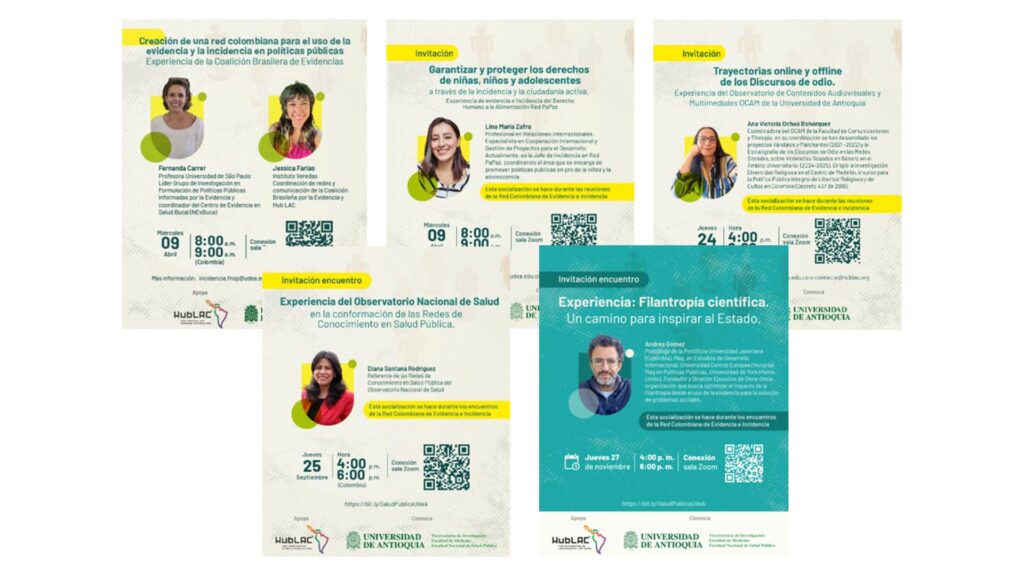
These interactions contributed to the development of the network’s strategic foundations, which are now available on the website of the National Faculty of Public Health at UdeA.
The network also had a presence at key events, such as Evidence Week (October 16, 2025) and the Policy–Science Interface Convention (October 28 and November 13, 2025).
Subtitle: some of the events held in 2025 by the Colombian Network for Evidence and Policy Advocacy
How does the Network work?
Organizations dedicated to the generation, synthesis, communication, or use of evidence, as well as those focused on policy advocacy, may join the network. Its functioning is guided by principles such as interdisciplinarity, plurality, transparency, social responsibility, equity, collaboration, and the absence of conflicts of interest.
The Network’s governance currently includes a facilitation team, which meets once a month and is responsible for coordinating the strategic direction, organizing meetings, and facilitating collaborative work. Through planning meetings, the team works closely together to advance the network’s strategic objectives. Anyone interested may participate in this team.
Based on the collective construction of its foundations, the network structured five strategic lines: capacity-building, stakeholder articulation, communication and dissemination, research and innovation, sustainability, and resource management.
According to María Paulina, Policy Advocacy Officer at the National Faculty of Public Health and a member of the Network’s Facilitation Team:
“The meetings were divided into two parts: in the first, we learned about an experience that connected evidence with public policy, along with shared learnings. In the second part, we began working on planning our network through guiding questions and online dynamics. The major achievement of this year was this strategic foundation. Reaching a collective agreement among so many people on objectives, principles, and lines of action is, for me, very significant.”
In this way, the network also established an open-access knowledge and evidence management approach, resulting from a collaborative and inclusive construction that is rigorous and of high quality, as well as timely and relevant for decision-making. Among the resources already proposed are a participant directory and a website presenting the initiative’s strategic foundations.
Challenges and next steps
The main challenges for 2026 include increasing participation in meetings and developing a work plan that responds to the expectations and interests of the network’s diverse members.
A national planning meeting is scheduled for early next year.
How to participate
Those interested may register their interest using the form:
👉 https://forms.gle/RFSUZPfxgsADSsMu9
For more information:
📧 incidencia.fnsp@udea.edu.co
📧 contacto@hublac.org
The form for submitting ideas and proposals for the work plan also remains open here.